

Canaf is a $14.9M market cap business with $9.8M in net cash that earned $2.3M in 2025. The CEO is redeploying capital derived from a South African commodity business into higher-return opportunities.
I believe margin expansion and continued growth are inevitable, which should lead to an aggressive rerating. Even if the foregoing fails to materialize, I estimate liquidation value per share to be ~15% below current price, creating a huge margin of safety.
All numbers are in Canadian Dollars.
Christopher Way took over as CEO in 2011, shortly after graduate school. He inherited inefficient, low-margin facilities and a fragile balance sheet in a very lumpy industry.
Most earnings had to be redeployed into building new facilities and improving legacy ones. During his first five years, Way secured longer-term contracts with customers, built and acquired higher-efficiency capacity. Gross margins improving and flat SG&A allowed him to start looking elsewhere to deploy capital in 2018.
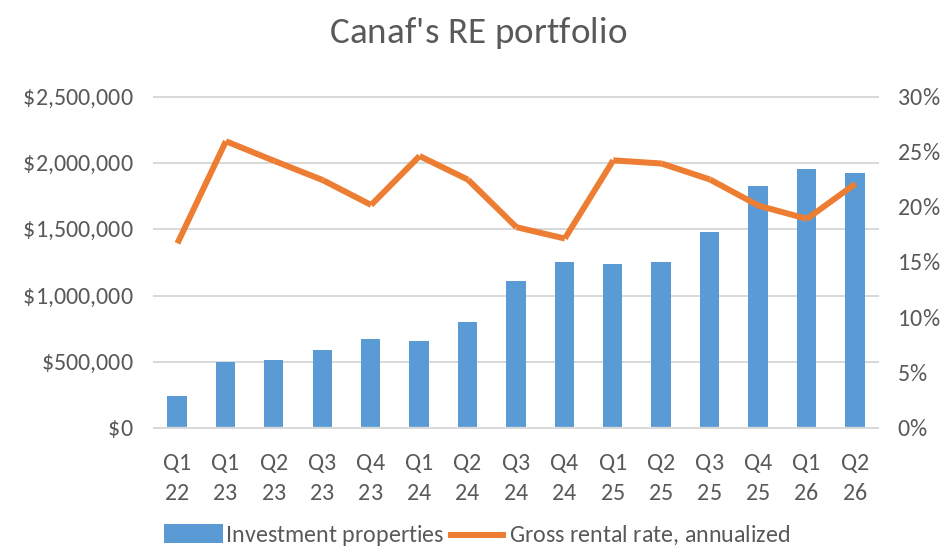
In 2019, Christopher began testing the RE market in Johannesburg. After a successful first rental property, he methodically grew the portfolio, which now stands at $1.9M. Canaf owns 15 investment properties, yielding ~14% pretax returns, and it’s expected to grow over time.
Three years later, Canaf received authorization to build two additional coal and anthracite devolatilization facilities. The permit expires in 2027 and management has not yet acted on it. If the decision is to not pursue further investments in the commodity business, it will be a great signal.
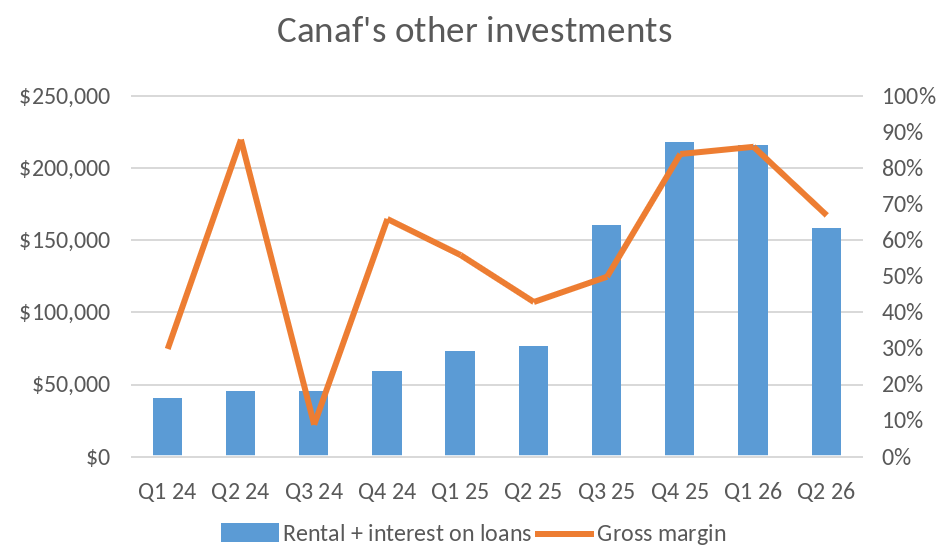
In 2024, Canaf started providing secured, short-term financing to SMBs through a third-party provider. They tested over one or two quarters and grew the portfolio to a current $1.6M, with target of ~$2.3M. Returns on this division are expected at ~2% per month.
This year, Way began the next venture. Urbanhold is a joint venture that will leverage empty space in shopping malls to build self-storage facilities. The first pilot test of 100 units is underway. If returns and demand prove satisfactory, management plans to grow it to 1,500 units initially. If fully built, these units will represent ~$2M in investment.
Christopher is diversifying Canaf away from the commodity business. Even within it, he expanded customer base and secured stronger contracts. Though I can’t tell for certain, I’d expect the next ~$6M in cash to be deployed into current opportunities. Ceiling on deployment size is unclear. If too large a cash position gets built, I’d expect him to turn to M&A and return capital to shareholders, especially since he’s a large shareholder himself. Way owns 16% of Canaf, bought mostly through open-market purchases.
The large cash position was only built over the past six years. I think investments will increase as Way feels more confident in the different projects. For starters, the ~$3.9M deployed is generating $530k in annualized EBIT. EBIT derived from properties should grow as more units are brought to market, pushing blended pretax returns to ~15%.
Financials
Canaf reported revenues of $13.3M in 2011, the year Christopher became CEO. An abrupt down cycle followed after China slowed down its investment in infrastructure. During the downturn, Canaf announced their purchase of a third coal-processing facility for $1.9M, financed ~70% with debt. The facility operated at higher efficiency than legacy ones, which were subsequently refurbished to adopt the better mechanisms. These measures led to improved gross margins over time.
The calcined anthracite business has widely varying margins, given the high fixed costs associated and the cyclical nature of the industry. My sense is normalized gross margins for the main business hover around 10-12%.
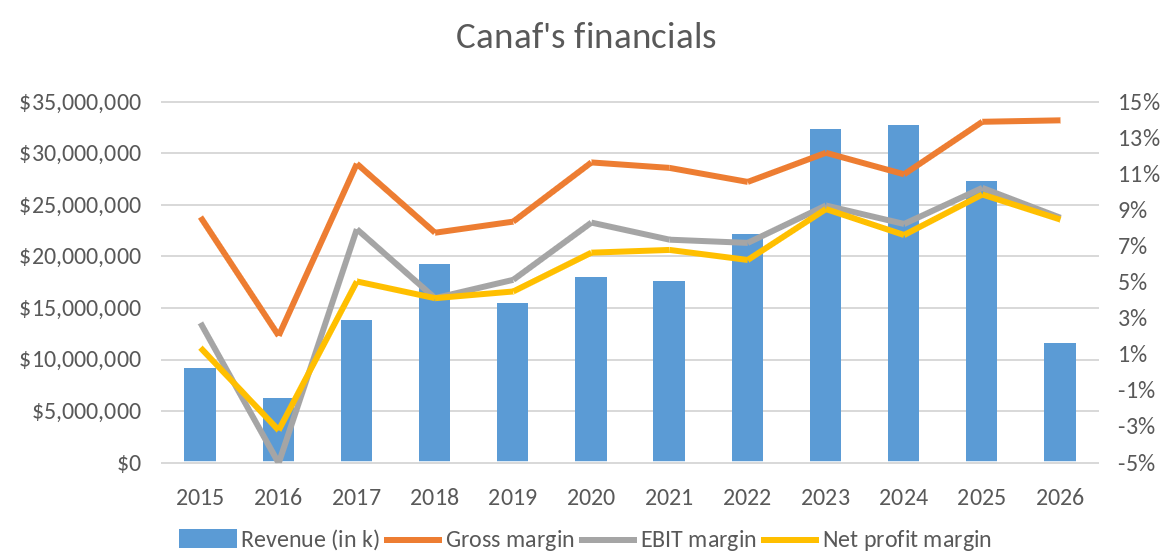
The recent uptick in profitability is due to Canaf’s investments in real estate and short-term asset-backed financing. The combined gross margin for these has been at 60-70% for the past year. Although these segments contributed just 3.2% of total revenue in the first half of 2026, they generated 18.5% of total gross profit. Margin expansion should continue as long as management keeps deploying cash outside Quantum.
Christopher has invested $1.9M in properties and, though not static, ~$2M in the financing business. Out of $3.9M deployed, Canaf is generating ~$530k in annualized EBIT, implying pretax returns of 13.5%. EBIT will grow as more residential units become available, which should push returns to ~15%.
Though ROIC is not stellar, I’d bet management is aware of it, and they’re moving to increasingly higher-return projects, insofar as opportunities are available. Irrespective of whether they continue allocating in current opportunities or new ones, such a transformation in the business economics should lead to an aggressive rerating.
In addition, Canaf has systematically shown that the business throws off more cash than it consumes. CapEx has not exceeded 5% of sales in any given year, and it rarely consumes all cash from operations.
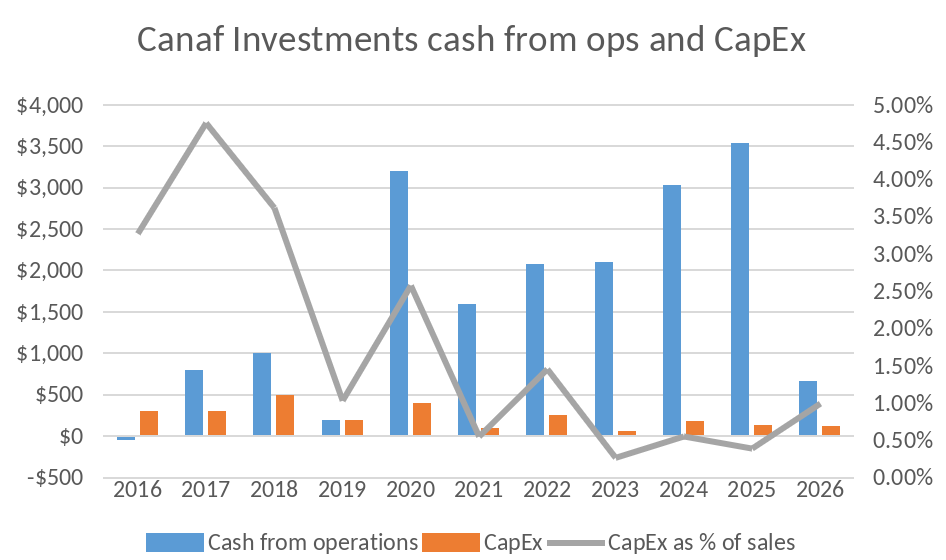
Since 2020, the business has generated over $14M in cumulative free cash flow. If Cristopher doesn’t find enough opportunities to deploy capital, I believe dividends will be on the table, as the stock is too illiquid for a meaningful buyback.
The price for which Canaf sells
There are 47.4M shares outstanding, a count that hasn’t increased since at least 2013. At a $0.315 share price, market cap is $14.9M. With $9.8M in net cash, EV stands at ~$5.1M. However, take a look at the balance sheet and you’ll land at an adjusted EV that’s far lower.
ARs cancel out with payables. Then you have $1.6M currently tied to the loan portfolio, $1.9M in investment properties, $1.7M in inventories, and $600k in PPE. After haircuts, you get a liquidation value of ~$13M, or $0.273 per share.
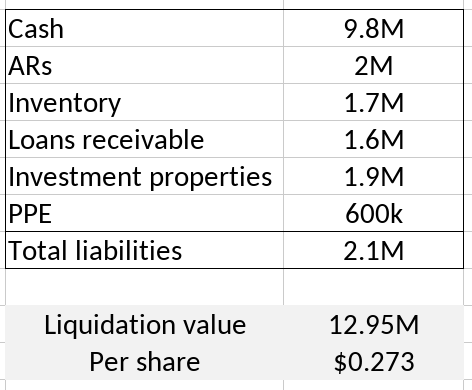
Even if you were to stick to the coal processing business, and sell off everything else, you’d be paying an EV of ~$2M for a normalized EBIT of ~$1M-$1.5M * 70% (considering another party has a 30% stake in Southern Coal).
Final Remarks
Christopher was dealt a pretty terrible hand and I think he’s playing it extremely well. Since he took over in 2011, book value has grown from $1.1M to $15.8M while issuing no shares.
I suspect the only reason why he didn’t turn to other investments earlier was the need to stabilize and make the core business systematically profitable. In doing so, Way utilized the little excess cash that was generated.
After securing stable cash flows, he started investing in RE, generating 14% pretax returns. Maybe he later realized returns could be higher elsewhere. The lending division has ~20% pretax returns, though subject to default risk. Now Way is taking small steps in the self-storage business, which I would suspect has 20%+ pretax returns and very low maintenance capex needs.
Christopher is in mid-to-late 40s, I believe. The fact that he has independently reached the conclusion of redeploying cash into higher-return assets, and actually doing it, is highly reassuring. I suspect he’s becoming an extraordinary operator in addition to a high-integrity CEO; provided that he acquired most of his stake through open-market transactions.
Feel free to ask any Qs to me at giulianomana@0to1stockmarket.com
Disclaimer: I own a position in the security mentioned at the time of this writing. This should not be taken as financial advice. Do your own research.
All numbers are in Canadian dollars.