

NTG Clarity Networks generated $83M in revenue and 10.7M in operating income during 2025. It trades at $19M market cap. I estimate liquidation value to be ~$26M, or $0.52 per share; this in contrast to its $0.38 share price.
For various reasons, revenue growth stalled, margins heavily contracted, and cash flow turned negative. I’ll explore why I think these are mostly temporary issues and why the business should rerate aggressively as things normalize.
The business was founded in the 90’s by Ashraf Zaghloul, who remains as CEO. NTG built proprietary OSS/BSS software for telecom operators alongside implementation services, expanding into the Middle East roughly two decades ago.
Between 2016-2021, management made three major changes: (1) they began focusing on clients in the finance/banking industries and system integrators serving government programs; (2) became a software development outsourcing business, placing engineering resources directly into client operations; (3) created an offshore solution by employing talent in Egypt.
After decades of flat-declining revenue and random profit-generation, these decisions led to explosive growth and an increase in profitability.
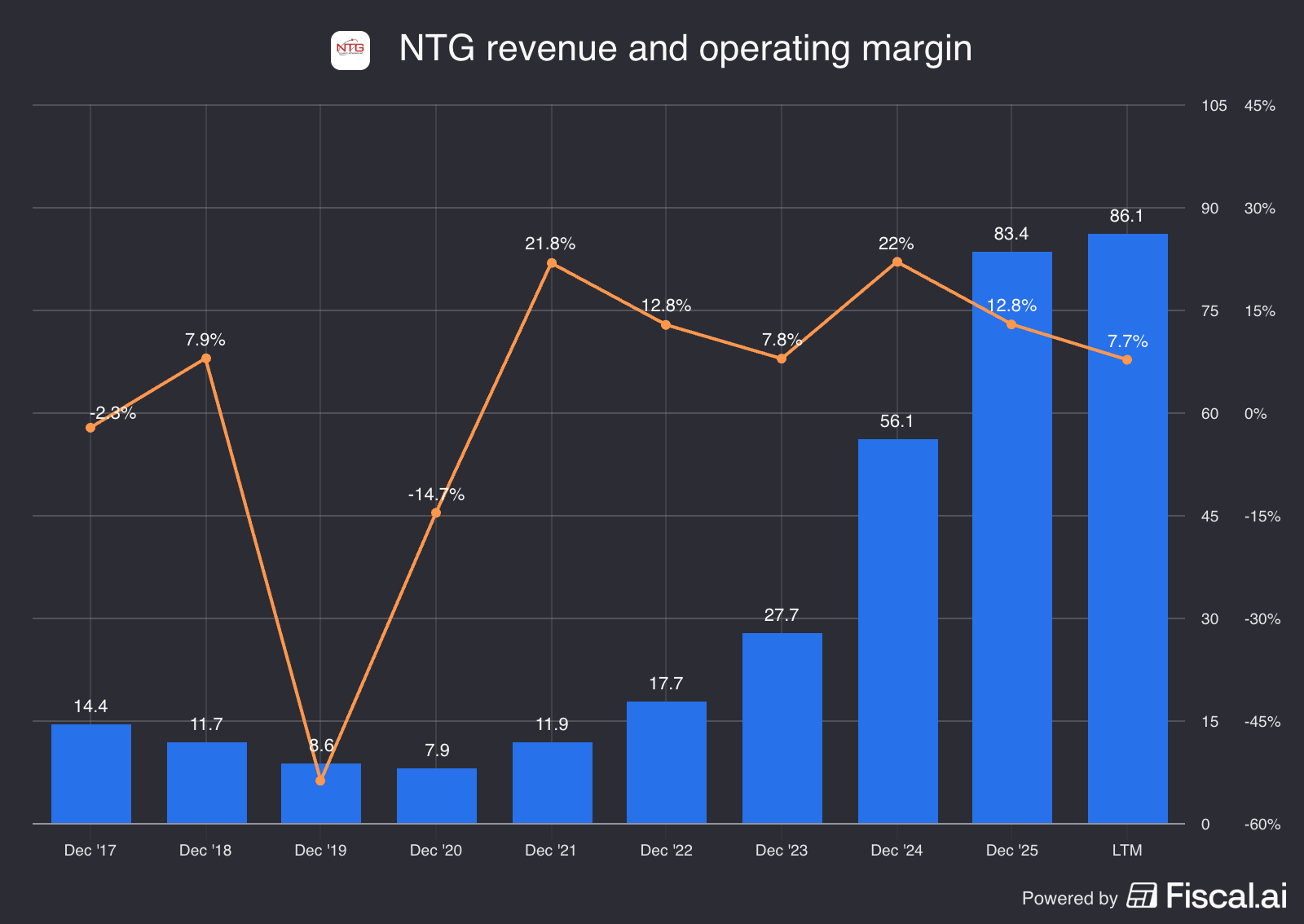
Operating margins I think are now structurally higher because of the offshore solution. By hiring in Egypt, NTG delivers cost savings of up to 50% to clients vs those who onsite, with the benefit that Egypt shares timezone, culture, language, and has a great talent pool for Saudi customers. Offshore sales currently represent 52% of total, up from under 10% five years ago. Maybe the increase in profitability is also due to the simplification of the business, now focusing on mainly one offering.
Growth bounced because it was the right place at the right time. In 2016, Saudi Arabia’s government established the 2030 Vision, a program aimed at diversifying the country’s economy from the O&G industry, favoring investments in other industries. Budget for the program was set at over $1 trillion. NTG’s rebranding to a digital transformation company was perfect for industries like banking, which remain undeveloped digitally, and are favored by the Saudi Vision program.
In addition, new contracts proved stickier than before causing revenue to be largely re-ocurring. Gross dollar retention sat at 99% for 2025 and net dollar retention at over 130%, meaning NTG kept almost every dollar worth of customers and, on average, they renewed & increased contract size. A customer not renewing is akin to saying they’re firing/downsizing their own software development team.
Why the opportunity exists (it’s ugly)
Multiple reasons resulted in such large dislocation. For starters, the conflict in the Middle East had presumably not affected NTG’s business until the just-reported quarter. In Q1, management said they had not seen a slowdown in customer spend. In Q2, the slowdown happened, and customers began demanding better pricing due to the uncertainty. Due to this reason, guidance was withdrawn, even though it was very conservative.
Secondly, software and consulting have both taken a huge hit over the past two years on fears of AI eating their business away. NTG belongs to both industries; part of the selling pressure might’ve come from this direction.
It appears to me that this narrative has started to shift earlier this year, but there remains a long way to go.
Thirdly, accounts receivable increased from ~$3M in 2021 to $35.7M as of the last quarter. The last two years, A/Rs have particularly increased while management explicitly mentions they’re working on getting them under control. NTG is selling more by financing customers, and only a few ones; 71% of 2025 sales originated from five customers. Days of sales outstanding increased from a low 63 in 2023 to 125 in last Q, with 69% of receivables belonging to top five customers.
The foregoing has been a huge drag on cash flow, which brings me to my next point. NTG has been profitable every year since 2021. However, cash flow turned negative in 2025, using $2.6M in operations, and they burned $4.6M in the last quarter alone. Payables decreased; ARs and prepaid expenses rose.
In addition, NTG is going through an investment cycle. In late 2024 and 2025, management began conversations with customers to extend the duration and size of contracts. At the time, NTG didn’t have enough people to satisfy this demand. Therefore, management hired hundreds of resources, whom they keep on their SG&A and cost of sales alternately, to be prepared for when these contracts finally land. Goes without saying that large contracts have taken much longer than management initially thought.
In 2024, NTG earned $12.3M of operating income on $56M of revenue. In 2025 it earned $10.7M on $83M; the difference is G&A rising from $5.5M to $13.1M.
During the last conference call, Adam (son of founder; investor relations) mentioned they’re investing $1M per month to keep these people. And for the first time, he admitted management is seriously evaluating whether it makes sense for this to continue.
Management
Ashraf Zaghloul founded the business in the 90s and remains as CEO. Adam took over investor relations, intensifying his efforts in spreading NTG’s story since 2019-2021. This has been crucial in giving a face to the business. Kristine Lewis is NTG’s president and has been with the company for decades.
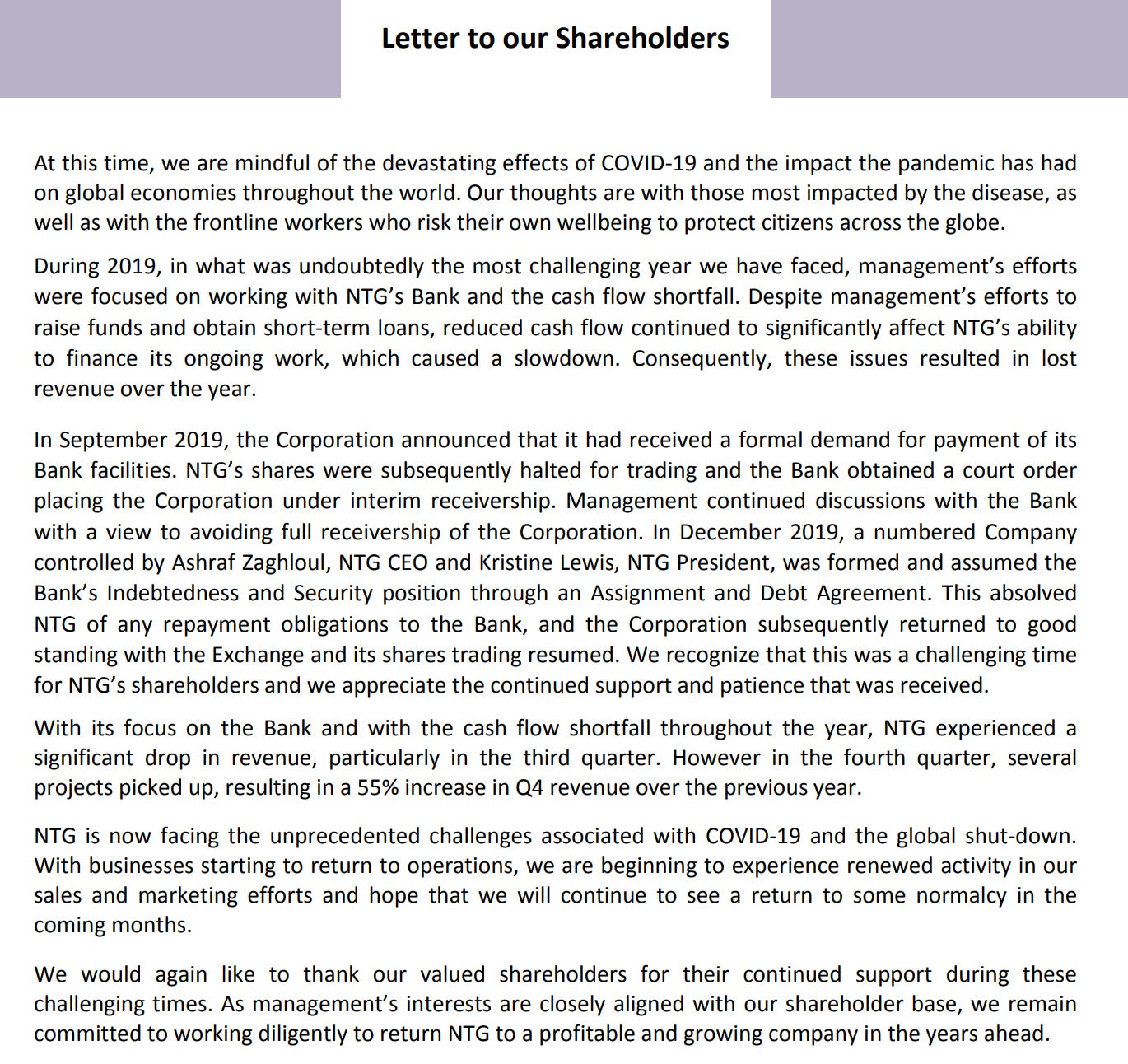
In 2019, when NTG was facing absolute hell, management stepped forward. The business had turned cash flow negative and revenue decreased 30%+. In that context, the bank called on their loan and gave NTG 10 days to pay; only that NTG didn’t have the money. The bank obtained a court order placing NTG into interim receivership, and NTG’s shares were halted. After negotiations, Kristine and Ashraf bought out the bank, assuming the ~$7.1M debt themselves.
The management-owned debt is at favorable rates and on flexible terms, with ~$5M still on the balance sheet. During 2020-22, Kristine and Ashraf converted part of the debt and unpaid compensation into equity (at distressed prices).
Insider ownership stands at ~35%, most of which was obtained through the just mentioned mechanism. A smaller piece comes from a $1.1M private placement in 2023 at $0.03 per share, where management participated.
Importantly, their share position was consolidated after a reverse split they made in 2024. Thereafter, management didn’t supply fresh capital, the equity markets being readily accessible once again.
NTG raised $6M in 2024 by issuing shares at $1.4 per share through a private offering. Each common share had half-a-warrant attached to it with exercise price at $2 per share. Finally, in 2025, NTG raised ~$9M at $2.2 per share through a LIFE offering. Capital was used to fund growth.
Despite having issued equity a few times, Adam mentioned in late 2025 they were considering buybacks. As the share price collapsed further, buybacks remain among the priorities, though they need to stabilize cash flow first.
The price you pay
There are 48M shares outstanding and ~1.5M in-the-money options - weighted avg exercise price of ~$0.26 - bringing total diluted shares to 49.5M. Around 1.1M options also exist with a weighted avg exercise price of ~$1.
Then there are 1.8M warrants at $2, expiring in September 2026, followed by a tranche with $2.9 exercise price expiring in July 2027.
I would not count warrants as dilutive instruments at said exercise prices, added to the fact that NTG would receive cash in exchange.
Putting everything together, I arrive at a broad liquidation value for NTG of ~$26M. I apply no haircut to ARs because there is no history of bad debt and 90% of receivables are aged under 90 days.
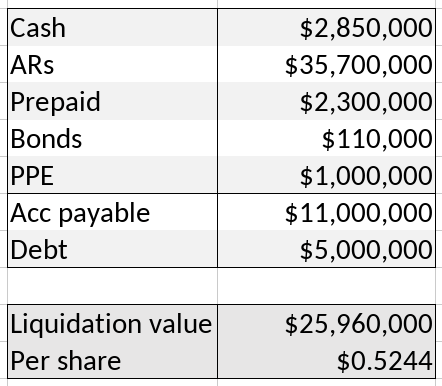
If we were to be more cautious, there’s still room for write-downs and we’d still be trading at below liquidation value. Even further, current assets exceed all liabilities by $24M, which is 20% higher than NTG’s market cap of ~$19M
Final Remarks
I think headwinds are temporary because: (1) the conflict will eventually end; (2) Saudi Arabia is committed to Saudi Vision and the conflict reinforces that even further; (3) narratives change over time; (4) larger contracts will materialize or $12M in annual cost savings will be unlocked; (5) management simplified tax structure to avoid double taxation, which should enhance profit margins; (6) client retention and NRR signal strong ties.
Things don’t have to go great to generate a good IRR by investing in NTG. Them not going terrible should lead to decent results, and only one of the negative factors reverting might be enough for a re-rating.
If management executes on at least collections, the business will be well. Absent cash conversion, they have the layoff lever to pull, which although not great, it’s unreasonable for shareholders to pay $1M monthly for no benefit. Nineteen months of this cash inflow represents the whole $19M market cap.
Having said this, I agree in that keeping people has been a good decision, and it’s a good decision insofar as larger contracts materialize. Good operators invest in bad environments, but they also know when to stop.
If nothing goes in NTG’s way, it’s likely they’ll need to raise capital to keep the business afloat. I think said scenario is not extremely unlikely and, if it were to play out, it’d be quite hurtful for shareholders. Good thing is that incentives are aligned, and management would be diluted alongside us.
Management controls the company, and this falls within the world of potential risks. However, when NTG faced absolute hell during 2019, Ashraf was direct and did not try to hide the truth.
Disclaimer: I own a position in the mentioned security. This is not financial advice and should not be taken as such. Always do your own research.
giulianomana@0to1stockmarket.com | reach out if I’m missing something.