

Each of these should alter the way you see things - upgrade your mental software. From climate change to aging and common patterns among business, biology, and physics.
I collect ideas from books, thoughts, anecdotes, and through observation.
This will be a long read. At the end, the full list will be included. Feel free to skip to the tl;dr and share, or bookmark for the full read later.
1. If you find a genius, give them all power
There come times in life when you encounter extraordinary individuals - people whose abilities are well in excess of your own. A handful of those times, you’ll also recognize a deeply moral drive. It doesn’t happen very often. It might only happen 1-5 times in a lifetime. But you need to be on the lookout. When you come across one of these people, partner with them.
Studying the life of Lee Kuan Yew flabbergasted me. Singapore was a malarial swamp. No common culture, no people, and no country wanted to help them at the beginning. Citizens didn’t even speak the same language. Then this man came along and he single-handedly fixed all societal issues, turning Singapore into one of the richest countries in the world by per capita GDP. LKY couldn’t have done it alone; he had a great team of ministers and advisors. That’s another feature of these astounding individuals: they know how to build an exceptional team.
Warren Buffett became Berkshire’s CEO in the late ‘60s. He turned a mediocre $15M textile operation into a $1 trillion conglomerate, while earning essentially no salary and partnering with Charlie Munger.
Imagine you knew a young Buffett. The single decision of handing him your money would make you end up billions of dollars richer. And you wouldn’t have to lift a finger.
A Buffett or Lee Kuan Yew kind of talent might come once every century. And in all likelihood, we won’t meet people like them. But the idea holds true at all levels. Think of that marketing agency whose performance is 2-3x that of the other agency you hire. Think of the person who manages 1-2 people, but whose results are astounding and could manage 10-50. Think of your incredibly smart friend who could and would do a lot but has no resources. Life becomes easier as you stack tailwinds.
2. You are neither right nor wrong because a poll agrees with you
You are right because your facts and reasoning are right; because the outcome was similar to what you predicted. Other people’s opinions has nothing to do with the truth. Truth lives by itself. It’s independent.
Until Darwin, all naturalists believed in the independent creation of species. After Darwin, almost no one did. Everyone thought the world had been created 5,000 years ago; after Lyell published his work, no one thinks that. Before Copernicus, people thought the Earth was at the center of the solar system. Before Galileo, that a heavy stone fell faster than a light one.
What society holds true at any point in time is fragile. It only takes one observation to shatter it completely and for a new paradigm to emerge.
When Henry Singleton took over Teledyne, dividends were the only conceivable way in which companies could return capital to their shareholders. He figured that, done well, buybacks could create more value and proceeded to repurchase shares when multiples contracted in the 70s. Thereafter, everyone on Wall Street caught up with their tax efficiency and started doing share buybacks periodically. In the 90s, Singleton had his last interview and was asked what he thinks of this development:
“If everyone is doing them, then there must be something wrong with them.”
3. The key to success is mediocre competition
You are always competing with someone. For attention, a position, a candidate, a customer, an audience. Every activity, meal, or plan competes with every other, time being the only true asset.
Winning can be a win-win, but that doesn’t mean there isn’t a loser somewhere. Imagine you pitch your product or service to a potential customer. After your meeting, the customer meets another vendor. What determines whether you win is not only your performance, the quality of your service, and soft skills, but also how they compare to your competitor’s. How much easier it’d be if their product weren’t functional or they didn’t show up?
It’s not about taking advantage of other people. It’s about being smart at game selection. You’ll end up competing anyway, so you might as well pick something where you have an edge over other people. You must be capable of telling where your edge comes from. At a poker table, ‘if you don’t know who the patsy is 30 minutes into the game, then you are the patsy’.
Niches are large enough to support a family and fund growth. If there is demand, and you control a tier of the supply, you’ll do well. Doesn’t matter if you’re Alaska’s best fisherman. If you’re the best at something for which there’s stable demand, you’ll do well. Buffett oftentimes said that the best shield against inflation is being the best lawyer or doctor in town; your earnings are protected because you supply the market with a high quality product that’s continuously in demand.
4. There are answers worth billions of dollars in a $30 history book - Munger
Near the end of his life, Charlie Munger often told an anecdote later in life:
he read an investment magazine every year for 30-40 years and had never found an actionable idea in it... until the 2010s. Charlie subsequently invested a couple million in the business portrayed and took out $80M in profit. He gave that $80M to Li Lu and Li Lu turned it into ~$400M. All of this in the span of under 15 years, I believe.
That’s how powerful reading can be, especially in investing. It only takes one idea to change your life. Imagine if you knew everything you now know when you were 10-20 years old. Would you exercise? Would you invest? Would you read? Would you spend more time with relatives?
You are not smarter than your former self. You’re just more knowledgeable, hopefully wiser. Knowledge is power; it brings profit in all shapes and forms. And the best thing is that it is, to a large extent, ‘speed-runnable.’ Read 1,000 carefully selected books and I suspect decisions become simpler. It’s immaterial if you read those 1,000 books in one decade or six decades. I strongly suspect you’ll take away most insights anyway. The difference is that you have that mental database to compound and work for you for five decades thereafter.
You don’t need to make all mistakes there are to be made. Learn from people who came before you; avoid the mistakes they made and take their advice. Life is very much the same in many ways. And you don’t have to figure out Newton’s laws by yourself; you won’t be able to, or you’ll spend your whole life trying. Just read about them. It’s a fair shortcut.
5. It’s always a skill issue
If you don’t get what you want in the long run, it’s likely on you. This is especially true nowadays, when opportunities are widespread; the internet and now AI have leveled the playing field.
This reframe is extremely impactful and pragmatic. From: It’s another person’s fault. To: It’s my fault. If it didn’t turn out the way I wanted, I could’ve done something better.
It’s a reframe about responsibility and accountability. If you take it, you’ll learn something from it. And your behavior will thereafter be more profitable. You can always do something better. You can always be better. Failed at an interview? Maybe my English or knowledge are off. Failed at an exam? I didn’t study hard enough. Don’t know how to close a customer? I’m not a good enough salesperson yet.
There’s always someone who could do what we’re supposed to do better than us. And not because they were born with it. They acquired the skill.
“The easiest way to get what you want is to deserve what you want”
No one is a natural at anything. The rate of learning plays a big role in how quickly you arrive at a proficiency level and acquire new techniques. But not even the most remarkable human beings could’ve gone far without intense practice and focus.
When I read da Vinci’s biography, I was astounded by his obsessive personality and the attention he gave to getting every little detail right. Talent can only take you so far. There is no substitute for hard work.
Whatever another person has, you can have (naturally limited to changeable things, which I’d estimate to be in excess of 97% of cravings). Some achievements and results take more effort and time, but there’s no rule why you can’t reach a certain summit.
‘Aim for the sky. For, even if you don’t get there, you could reach the clouds.’ Improvement is deeply satisfactory, irrespective of whether you reach your original target. And time will pass anyway, so you might as well do something.
6. Cargo Cult Science
Feynman gave this speech in the ‘70s. He warned the audience about the upcoming new ‘science’. They’ll say their conclusions have a scientific basis, that they followed the scientific method, and that their opinions are just as valid as those forged through sweat and tears in the fields of mathematics and physics.
But they are non-knowers. They lack intellectual integrity and rigor, and ignore how difficult it is to produce any piece of knowledge. When trying to explain a phenomenon, the way to establish causality is by isolating variables in an experimental/observational manner and running tests.
Some of these people don’t realize their disciplines fall into the complex adaptive systems realm. Many variables impact any given outcome, and all of them are interconnected. Isolation is virtually impossible. And true causality can’t be determined because the environment continuously changes; new set of rules, the experiment is no longer the same.
Furthermore, if they do know this and insist on their newfound truth, it’s likely that they are not disclosing the whole picture. Failed experiments are left out of their papers and noisy data goes unreported. Only elements that validate the conclusion are presented.
Beware of people who claim they know something that’s really hard to know. The best shield is to deeply research a topic. See for yourself how hard it is to stay on the tracks of truth to not misinform others. Or you can lie to yourself, and others will play along.
“The first principle is that you must not fool yourself - and you are the easiest person to fool.”
7. The men who can manage men manage the men who can manage only things, and the men who can manage money manage all - Durant
The output from your employed capacity is a function of how much leverage you have and how well you use each unit of time. If it’s only you getting paid per hour, earnings scale linearly with your input. If you have the eye or skill of a master, you might get paid per project or earn a share of the generated proceeds; output becomes nonlinear. If you manage people and get to decide how they employ their time at work, the foregoing multiplies. If you can manage money and understand returns on time, everything will be at your disposition.
8. Incentives
We repeat behavior that rewards us and avoid that which punishes us. No one wakes up wanting to bang their head into the wall. Pain is terror, in all forms. If a conversation with your friend was unpleasant, you won’t want to go through it again. And thus you might see that friend less often, even if the unpleasantness wasn’t out of a personal issue. We are wired this way.
Man’s genome took billions of years to evolve. On an Earth were catastrophe abounds, mechanisms were built into our DNA to preserve ourselves. Everything in your circuitry is optimized for self-preservation and reproduction. What is pain if not the body telling you you’re being constrained in one way or another from the thing for which you live?
If you want something to happen, align everyone’s interests toward it and it will. We only do things that are in our interest; the self-serving bias is too powerful. Generosity does exist but there’s truth to the idea that there’s no action that’s purely altruistic.
“Reason, justice and equity never had weight enough on the face of the earth, to govern the councils of men” – John Adams.
It is interest alone which does it. When there are enough incentives, anything can happen. In the 1930s-40s in Russia, there were quotas to fill for arrests. It didn’t matter if people had done a wrongdoing. Quotas needed to be filled and any pretext was good enough.
There was an organization with two products. One was higher quality and it didn’t sell for a much higher price, yet nobody bought it. After some inquiring, management realized salesmen received a higher commission if they sold the lower-quality product. Managers inverted the commission and sales of the higher-quality product eclipsed the other.
Pavlov ran thousands of experiments with dogs to investigate reflexes. Most tests had the secretion of saliva as the objective, which in a natural setting happens when food or poison enters the dog’s mouth. Pavlov found dozens of stimuli that could be conditioned to trigger this reflex. You can use the sound of a bell to trigger saliva. Organisms’ cabling can be reconfigured to suit your needs. Whose bread I eat, his song I sing.
In finance, investment bankers connect companies that want to acquire others with potential targets. They are the deal makers and receive a cut of the transaction for their services. Because it’s in their absolute interest for a deal to be struck, their unconscious will push for it to happen, even if it’s not in the company’s best interest. Don’t ask your barber if you need a haircut.
I’ll finish this section with a story my father told me once. He was working at a consulting firm and had a group meeting. The manager who was leading it arrived 5 minutes late. So the guy comes in, everyone already sitting, and starts playing with the document he had at hand. Then he pounds the table and says, ‘Gentlemen, are we gonna do what’s right or what’s in our interest?’
9. Intelligent is different from smart, and both can be stupid
I think being smart is being quick of mind; smart people are witty; they compute/permutate quickly and are good at pattern-recognition at the micro level. Intelligence is broader, but holds less specific power. Intelligent people can see the depth to things; they know what questions are worth entertaining and can hold one in their heads for days until they get an answer; they see the whole board and seem to understand nature at levels others don’t. It’s pattern-recognition at a higher scale.
Intelligence lets you build your mental schemas, and brightness let’s you sort through your mental library to analyze the problem at hand, arriving more quickly at the answer. Both are extremely helpful attributes, but neither can save you from stupidity.
“It takes something more than intelligence to act intelligently.” – the Master
I suspect there’s a spectrum in intelligence that’s something like intellectual self-awareness. Up to a point, the more intelligent you are, the easier it is to act irrationally - you can argue in favor of anything, but are not intelligent enough to recognize blindspots that arise from the nature of things. You can even be a Nobel laureate and make terrible decisions, Long-Term Capital Management being the prime example.
We fall in love with our creations and are bound to overestimate our capacity. It seems like the more intelligent you are, the more difficult it is to accept some things are outside your control. Up to a certain point.
Nobel laureates in the field of physics seem to have long known how biased our judgment is. They don’t hold their ideas as True; they learned to hold them as the truth as of now. Studying history and how their field got to its current state forces that mental switch.
To this effect, ‘people who are in the top percentile of probabilistic games have more in common with one another than with people in their own fields’ - Michael Mauboussin.
It’s unclear to me whether this is a genetic element. But there’s something coded within some brains that makes them more resilient.
10. Worldly wisdom
The modern educational system was created to meet modern reality. We live in a world that’s full of long-tailed branches. It takes years of intense diligence to place yourself at the frontier of any knowledge vertical. And it takes even longer to reach a point where you can break through boundaries.
These 10-20 years of education leave us in a place where we don’t want to revisit academia. We think of it as this horrible memory where we were assigned terrible reads about things we didn’t care about. As a consequence, we leave proficient in one area while neglecting everything else.
This is a disaster. ‘You’re like a one-legged man in an ass-kicking contest’.
Real life problems cannot be isolated into neat boxes. Answering any question to any truthful extent requires knowing history, psychology, economics, physics. Problems are multifaceted and all disciplines are interconnected. The best decision-makers have a good understanding of the whole. They are generalists who also know their field extremely well.
Beyond that, how can you go through life without knowing? Learning brings profit, joy, and happiness. ‘You can’t expect to dream it up all by yourself – no one is that smart’.
11. Education is software for the brain
Without Windows or iOS, your computer would be an alien product. Impossible to use. Just by adding an operating system, it becomes this incredibly malleable, resourceful machine. Add software layers on top of it, install applications and learn how to use the internet, and there’s no problem you can’t solve. You’ll also save infinite time through efficiency gains.
That’s what education does to you. Reading a book adds ideas to your brain, words to your vocabulary, and you experience a wide range of emotions. Your mind acquires new lenses through which to analyze the world. And lenses compound; each hour spent reading builds layers of understanding. Decisions are filtered through them all, becoming sounder and more optimal.
12. Economies of scale
Manufacturing businesses typically have large headcount and maintenance expenses associated with their facilities. Both are fixed costs. As the company scales and sells more units, while keeping this fixed base flat, operating margins expand. The business becomes more efficient on a per-unit basis.
The same thing happens with organisms. The metabolic rate signals the energy we need to ingest to keep our machinery active. And it so happens that, the larger the organism, the less energy it needs per gram of tissue. Likewise, the larger the organism, the fewer heartbeats per minute it has. These represent huge efficiencies gained from scale.
In geometry, the area of a 2D objects increases with the square of their dimensions’ lengths. And in 3D objects, volume scales with the cube. So every time you double dimensions, in the former you get 4x the area; in the latter, you get 8x.
There are also inefficiencies that come from scale, such as the amount of weight a physical structure can support. The larger it is, the less proportional mass it can hold up. That’s why ants seem incredibly strong.
Sol Price figured out how to win in retail by understanding this and complementing it with his business savviness. As your business gets larger, you experience gains from efficiency. But your margin is others’ opportunity. Therefore, if you pass on your savings to customers by lowering your prices (Amazon, Walmart, HD, and Costco’s playbook), you almost can’t be taken out by a competitor.
13. Quality
A teacher stands in front of his classroom and reads two short essays aloud, both about the same topic and structurally similar. At the end, he asks students to raise their hands if they think the first one is better. *No one raises their hand*. Then he asks them to raise their hands if they think the second one is better. *Every hand goes up*.
You can try to quantify it. You can point to how sentences are framed, how commas are used, ratio of verbs to total words, pauses, and so on. But in the final analysis, you don’t know why it’s better. You just know it is.
We have an inner sense of Quality. It’s not taste or intuition, and it’s not analytical. It’s something you observe that can’t be seen. Something you hear that emits no noise. It’s a switch that gets triggered at the point where all our senses connect.
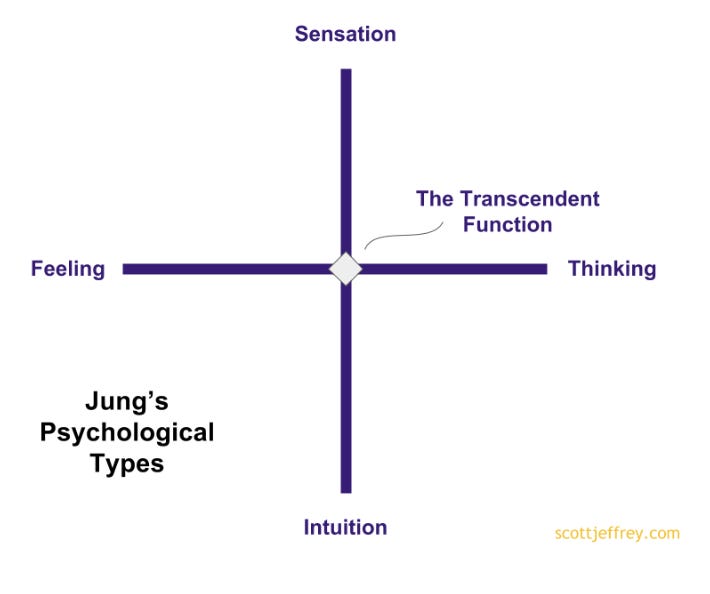
14. Extraordinary results are just 1,000 boring days strung together
Rocks can be worn down by drops of water. It takes a decade to create an overnight success. Think about any skill you’d like to be better at; then think how much better you’d be if you had practiced it every day for the past 3 years. It reminds me of the story of a great, old musician to whom, after the concert, a fan said to him, “My God, you play so beautifully. I’d give my life to play like that.” To which the musician melancholically replied, “That’s exactly what I did.”
Innate talent is not enough. Newton locked himself in a room for months to dedicate himself to any subject that was of interest to him; all day spent thinking. Da Vinci spent ~16 years painting the Mona Lisa; and decades of intense practice and learning about painting & drawing to perfect his craft. Francis Crick and James Watson worked on a single topic for 2-3 years filled with frustration before they could discover the double helix.
No one double-clicks on the long periods of darkness and nothingness. All the greatest have gone through that, but everyone remembers the fame and achievements.
To be acclaimed in front of everybody, you need to outwork everybody in front of nobody.
15. Stack the bricks
On one occasion, Steve Jobs was discussing a media strategy with an advisor. Both men ran into a disagreement, and the other guy did an experiment. He crumpled up a piece of paper and threw it at Steve; Steve caught it. Then this man crumpled up five paper balls and threw them all at once; Steve caught none. Everything works that way. We only have so many mental resources.
One of the reasons why Google and Apple won was their intense focus on what they wanted to show the customer. Internet pages had every pixel crammed up with images and information. Smartphones were anything but smart. Google got rid of everything except for the Search bar, and that’s perfect for users. iPhones had only one button; now they have none. If something is not required, delete it. You risk diverting users’ attention to things that don’t matter.
We look more at buildings than we do at floors. If you have 100 bricks and lay them horizontally on the floor, they amount to nothing. No contrast, no excitement, no novelty. Everyone will pass by; uniformity catches no eyes. Instead, if you stack the bricks and build a tower, there’ll be no person who walks by without noticing it.
Businesses think about marketing in the same way. They have recurring investment in S&M, but when something important happens, all resources get concentrated on that announcement. A new product, fundraising rounds, new partnerships. Companies might leverage all channels and networks to publicize the same event. Incrementally invested capital in directing attention to the same event yields increasing returns (up to a certain point).
This is analogue to how Marc Andreessen views venture capital: returns aren’t evenly distributed. It’s only a few that drive all results. If you develop an eye for what those few look like, concentrating resources is not only more profitable, but less risky.
16. There are multiple ways of thinking
Whenever da Vinci faced a problem and needed to think, he took out a pencil and paper and began drawing. If Leonardo set out to understand the motion of water, the flow of a river or the mechanics of sight, he just drew.
When I saw his drawings of rivers, I sensed how they acted as a mental model for da Vinci, or as an algorithm like those used to ‘forecast’ weather patterns. It became clear when I read he was working for Cesare Borgia. Leonardo came up with innovative military ideas. And the way he determined feasibility was by putting them on paper.
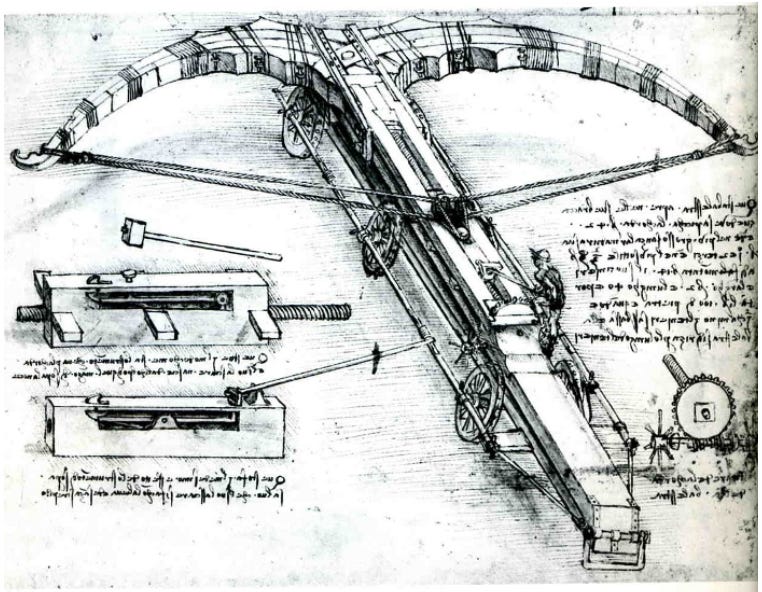
He was able to see whether something could work in reality by sketching it. And tweaking sketches was just like changing inputs in a computer simulator.
Learn how you think and leverage that. You’ll often hear people say that they are “visual thinkers;” some just want to sound fancy, but there’s deep truth in that statement. If you know how you think, you’ll be much more effective at everything you do in life. You’ll feed yourself the knowledge you need, in the right way, and optimize your environment according to your nature.
17. Real understanding comes through continued mental exposure
It’s not the same to read a book, which takes 15-35 hours, as it is to listen to a 1-2-hour podcast. And it’s not the same to read a summary of the book. You don’t get 80% of the job done; it doesn’t work that way. Understanding comes from continuously thinking about something, adding layers of information and theorizing about how new knowledge fits the picture.
Jung analyzed dreams by ‘turning them around and around, analyzing every single angle they had’. A thesis can just be a sentence: natural selection is the process by which superior organisms are selected based on their fitness and are thus able to yield offspring. But you don’t understand everything underneath; the pillars that back the theory up. Use and disuse, specialization of organs, tiny variations, shared commonalities. Those are what help you understand natural selection.
For what is understanding if not the capacity to profit from the knowledge?
18. Deep simplicity
Complex systems are the result of a few nodes interacting with one another, left alone for a long time. This stands true across disciplines:
95%+ of all biological matter is made up of only 4 elements (carbon, hydrogen, oxygen, nitrogen).
With 3 laws and gravity, you can explain and predict the motion of all (large) bodies.
All DNA is made of sugar, phosphate, and a chemical base, which in turn are built from pairs of 4 nucleobases.
Electricity and magnetism were separate fields until Maxwell. With 4 equations, he explained the most varied phenomena. At the bottom of things, only a handful of elements serve as the Lego blocks.
When performing any sort of analysis, look for the 2-5 variables that move the needle. It doesn’t matter how immense an issue looks.
In the early 1900s, Milanković wanted to understand why the Earth has this pattern of an alternating cycle of ice ages and warm interglacial periods.
After 30 years of thinking and manual calculations, he reduced this enormously complex phenomenon to 3 variables:
- The eccentricity of the orbit - goes from more to less elliptical in loop. 100,000-year cycles.
- The tilt of the Earth’s axis - obliquity. 41,000-year cycles.
- The wobble - slow, top-like wobble on its axis. 26,000-year cycles.
By tracking how these three variables overlap, he answered this impossible question.
Jeff Bezos did a similar thing when he said that a leader’s job is to identify the 2-3 big ideas and enforce execution against those. Amazon was built around: (1) Lower prices; (2) Faster delivery; (3) Broader selection. “It’s inconceivable to me to imagine a world where people don’t want that 10 years from now.” These are the things that don’t change and thus make a business resilient, while virtually guaranteeing positive returns on capital if you win.
19. Tweak a problem only slightly and you’ll turn it from impossible to easy
This approach is about finding pieces of information that seem to matter but are ultimately irrelevant to the final result. Then work around or avoid them.
What if asked you to pass a needle through a block of ice? It’s a physical impossibility. But if you heat the ice, it’ll melt and you’ll be able to pass the needle. Likewise, if you heat the needle, it’ll slide through. Learning different disciplines helps you spot shortcuts where others only see a wall.
The original insight came from Thorp. He was once given a geometry puzzle: find the volume of the solid part left after drilling a hole through a sphere given only its height. Because the sphere’s radius wasn’t provided, most students thought the problem was impossible to solve. Thorp tweaked the scenario by imagining the smallest possible sphere; one exactly as tall as the hole. In this extreme case, the hole becomes a single point and the ring becomes a solid sphere, turning a complex calculus problem into a 5-second mental calculation.
20. Systems naturally trend towards decentralization and specialization
Adam Smith pointed out the difference between a pin factory where labor is divided and one where everyone does everything. The former was orders of magnitude more productive than the latter. Focusing on one task increases your dexterity and reduces context switching. You become proficient at the task, while a jack of all trades is a master of none. Groups of proficient workers outproduce their counterparts.
Natural selection has caused a similar phenomenon in organisms. Darwin thought that the higher on the scale of Nature, the more specialized an organism’s organs. Organisms less fit for survival were those whose organs were too general-purpose. They suffer from the same disadvantage as the pin factory that’s full of non-specialists. Thus, a visible trend in nature has been the specialization of organs.
In economics, it has been at times believed that a central authority can set prices for objects and services fairly well. Reality proves that the foregoing belief is wrong. Hayek remarked on the flaws of such a system - a single entity can’t faithfully integrate all ever-changing inputs to make decisions. Thus, the trend within economics has been for prices to be set by free markets, to a greater or lesser extent. Arbitrage and incentives seem to make this the best alternative.
For centuries, Societies were been ruled by emperors, or hereditary monarchs. Senates have been introduced and tested in Rome and Greece, though subsequently again replaced by monarchies and empires. Aristocracy emerged as a precursor to democracy. Finally, society arrived at democracy as the optimum selecting machine to govern the affairs of man.
21. Complex adaptive systems
We’re used to extrapolating, to thinking linearly. When we see 1, 2, 3... we think the next number in the sequence is 4. Our brain plays great tricks on us by seeing patterns, real or not, and trying to solve for unknowns. This has great utility, but it’s not absolute. It works in mathematics and to a large extent in physics & chemistry; logic is power.
However, in most of life, it leads to terrible results.
Linear thinking breaks down when trying to explain most of reality.
Economics, psychology, sociology, weather forecasting, people management. Each of these has infinite subtleties. You can’t say that just because interest rates fell, asset prices will skyrocket; or that just because a person coughed, they have pneumonia. Most of reality is formed by complex adaptive systems, with an indefinite number of components and a compounded feedback loops. What one node does affects all others, which affects all others again in turn, and so on indefinitely.
Do a small change in input and the whole system gets shaken; the output is indeterminate. I once read that the world is its fastest computing machine.
22. Why thinking what no one else is thinking pays off enormously
History shows that we systematically improve our understanding of nature. Therefore, at any given point in time, Society has a set of ‘currently held truths’. These are placeholders. Bound to get displaced in the future. But they are the best we’ve got as of now.
In the 1800s, all naturalists believed in the independent creation of species. Darwin encountered no sympathetic agreement whenever he discussed his ideas with someone. Nevertheless, he published his work in 1859. After Darwin’s theory got out, everyone regarded evolution as the truth.
When that happens, there’s a huge switch in society. Everyone’s mental software gets upgraded. With new lenses, new ways of doing things come; new methods, analyses, and fields open up. They are all closer to the truth than before. And because that’s the case, more pursuits are profitable. Wealth is created and expands.
In investing, it’s not good enough to be a contrarian. You must be contrarian and right at the same time. There’s no point in a building being different for its own sake; it must be more beautiful, useful, resilient. The more people who disagree with you when you are right, the larger the payoff.
In general terms, if you manage to bring an idea to society, you are rewarded. And the farther it is from the currently held truths, the larger the payoff. In intellectual terms, there might be no single idea that brought as much profit as Darwin’s. There’s true value in stretching people’s understanding.
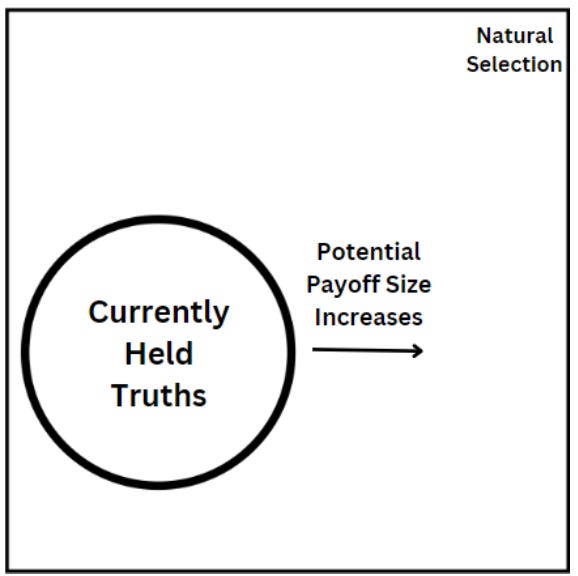
The two easiest ways to force this type of thinking come from one of Paul Graham’s essays: (i) Don’t be aware of conventions – if you don’t know what people think, you’ll think for yourself by default; (ii) surround yourself with independent-minded people – we are the average of the people that surround us.
People tend to think there are no more secrets out there, but a current example of this I came to appreciate is Graham Hancock. He posits that our record of history is flawed; Hancock believes there was an advanced civilization that got lost during the ice age and we haven’t yet put the pieces together. To argue, he pulls research from archeology, astronomy, sociology, and geology. It’s fascinating how he tries to connect the dots. And his view is forcing a whole re-thinking of everything.
23. The difficulty lies not in the new ideas, but in escaping from the old ones - Keynes
When we come up with or learn a new idea, theory, or process, it colors our view of everything. We fall in love with our creations and force new facts to accommodate to them. Any phenomenon we might encounter, we try to explain through our acquired idea.
That’s the man-with-a-hammer tendency; to the man with a hammer, every problem looks pretty much like a nail. He twists the problem at hand until he can crush it with the only hammer he holds. Hugely flawed way to operate.
Learning an idea costs so much that people don’t want to let it go to waste; they want to make as much use thereof as they can. Thus, science moves one funeral at a time.
24. You drift toward the average of your surroundings
We learn by imitation. Watching our parents conduct themselves teaches us how to conduct ourselves. While surrounded by peers, we copy behaviors from people we like or admire. You can’t fully resist this effect; it’s largely unconscious.
It has happened to me many times that I find myself expressing my views in a certain way and I wonder, ‘Why did I say that?’ Then I think deeper and realize, ‘Oh that came from Munger. That’s Feynman. That’s Buffett.’
When I was 7-17 years old, I spent a great deal of time with friends who played football; so I did that (loved it though). When I was older, I might meet with people who go to the gym more often, so I replicate that in some way.
Other people mold your behavior. And it’s a powerful force. If you meet with people who exercise a lot, you’ll be far more inclined to hitting the gym. If you gather around people who read a lot, you’ll start reading more and more. The obverse also holds true: if you surround yourself with smokers, you’ll smoke; if they don’t work hard, you won’t work hard.
It doesn’t matter how independent-minded you think you are. We tend towards the average of the 5 people who surround us.
25. Causes of human misjudgment
Our minds break in embarrassing ways all too frequently. You can’t avoid it. These failures are so deeply rooted that you can rarely tell when they occur; they feel natural. Worse than that, they feel right. And you experience great damage and suffering because of your wiring.
When anger comes, rationality leaves. Emotions cloud our judgment. And so do a lot of phenomena: if you are hungry, your decisions will be worse and your temperament more irascible; we fail to notice change that happens gradually; we twist reality when it hurts until it becomes bearable; we are more prone to agree with opinions of people whom we like; and so on. There are dozens of silent threats that lead to our misjudging events.
I think that, to a large extent, you can troubleshoot it. Learn new behaviors. What you can’t do is get rid of the intrinsic causes of malfunction. It works like addictions; you cure them one day at a time. The most practical way to do so is to become aware of all common errors and live in a state of alert.
A very useful piece of advice that’ll save you infinite trouble:
“You can always tell someone to go to hell tomorrow if it’s such a good idea” Tom Murphy
26. Find out what works and do it
Lee Kuan Yew turned Singapore from a malarial swamp into a thriving modern nation, which now ranks ~top ten in GDP per capita.
He wasn’t an ideologue; the only test is reality. For every issue he encountered, LKY studied what other nations did and how it had played out. If something had worked and was analytically sensible, he would do that – like changing incentives to fix traffic or offering tax benefits to multinational corporations. If something was a common cause of trouble elsewhere, he’d avoid it – like at the beginning, when he chose not to have a traditional central bank that could issue currency lightly.
There’s always a place where you can find larger density of what you’re looking for. Looking for startups? Go to SF. Looking for truths? Read the classics. Looking for mispriced investments? Fish where the fish are. Look where nobody is looking.
If you don’t look, you won’t find. When Buffett was young, he’d flip through the whole Moody’s manual searching for investment opportunities. Naturally, he found plenty. Whenever you search more, diligently, you’ll find more. Working hard tilts odds in your favor.
27. After a business gets to scale, capital allocation matters more than any other thing
The skillset that takes a business from $0 to $1M is different from the skillset that takes it from $1M to $10M, different from $10M to $100M, and beyond. Complexity escalates, product lines increase, markets get saturated, the business model might change, individual sales no longer move the needle. Success might start with product, grow through sales, and stabilize via operations.
However, as the business grows and it starts printing 10s-100s of millions in cash annually, what you do with cash inflow matters increasingly more. Growth is not just bound to happen in most businesses; markets saturate. At a 5% growth rate in a capped market, deploying that capital to expand the core business might not be worth it. By reinvesting it elsewhere, CEOs can create value for shareholders that’s orders of magnitude higher.
Good capital allocation drives lollapalooza results and makes businesses more resilient. When Buffett took over Berkshire Hathaway, BRK was a mediocre $15M textile operation with $50M in sales but $175k in profit. Instead of accepting that Berkshire was a textile operation, Warren built a portfolio of securities and bought companies like See’s Candies and Blue Chip Stamps. Cash flow continued to be used for M&A and investment in public equities. Buffett turned Berkshire into a $1tn, diversified conglomerate. Further, in the 2010s, one investment created $100bn+
“What Teledyne makes or sells is less important than the style of the man who runs it.”
28. History doesn’t repeat itself but it often rhymes - Mark Twain
The world has gone through a large number of permutations, state of things. And it’s in continuous change. Both elements yield the fact that past conditions are in all likelihood to repeat themselves, in a more-or-less fashion.
Not knowing what has transpired leaves you handicapped. Chess is not only a game of analytical ability, but also of memory. Grandmasters typically hold hundreds of previous games in their heads, so they know what to play given almost any situation. Life, albeit less deterministic, works the same way.
Being familiar with past market crashes prepares you for future ones. Even though each is unique, they’ll share common elements. Analyzing the fall of Rome or any past great civilization might lead to insight about the forthcoming fall of current powerhouses. Studying what worked and failed in other nations will give you a good sense of what will work in your own land.
Nevertheless, we need a mental routine that forces us to remember. Most tragedies resemble one another. And all happy families are alike.
But this lesson is easy to forget.
In one of the last sections from Lessons of History, a rising young politician is arguing with an old general; he’s laying out the case for how history has played itself out. At the end of their discourse, the young man pushes for the two current great nations to make peace with each other; he explains why it’s the best for the whole world. The old general smiles and says, “Son, you’ve forgotten all the lessons of history, and all that nature of man which you describe”
If you want to go deeper, read this:

29. Uniformitarianism vs catastrophism
There are two sides to this idea:
1. How did a system get somewhere.
2. What happened after the system got somewhere.
Biology is the field that really helped me better grasp this concept.
The Bible acted as the source of truth up to the 19th century. And it posits that God created species independently.
Then Darwin came along, who spoke about little variations per generation of species, and ecosystems (Nature) selecting the fittest therefor. Given enough time, organic beings completely differ from one another, reaching the state of different genus, and species.
But it is the sense in which it happens that matters: It’s a gradual, step-by-step process, in contrast to the Bible’s “catastrophist”/abrupt explanation.
Fast forward to the 1960s and Stephen Jay Gould came along, who spoke about Darwin being wrong. In the fossil record, Gould found that species went through long periods of stasis, followed by a Punctuated Equilibrium (a concentrated period of time where evolution pronouncedly occurred), stasis again, punctuated equilibrium, etc.
The theme doesn’t vary. Although fundamentally different from the Bible, the subject remains in the realm of catastrophism/abruptness.
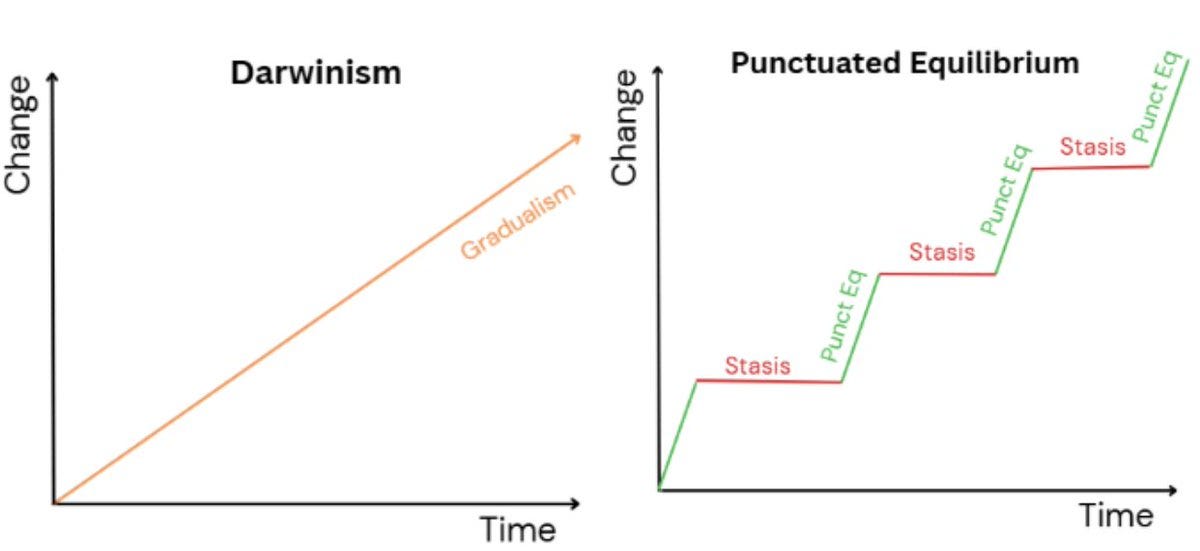
Second, we have what happens after a system gets somewhere.
And for this I’m going to turn to Economics.
Adam Smith wrote in the 1770s that society largely works well for resource allocation because entrepreneurs get rewarded in the form of profit if they find an exploitable market.
However, he knew people are not dumb. When others see someone making a profit, they’ll jump to that market and compete to get a share thereof.
Over time, he concluded, competitors will increase until the product’s price equals the cost of providing it. No profits to be made thereafter.
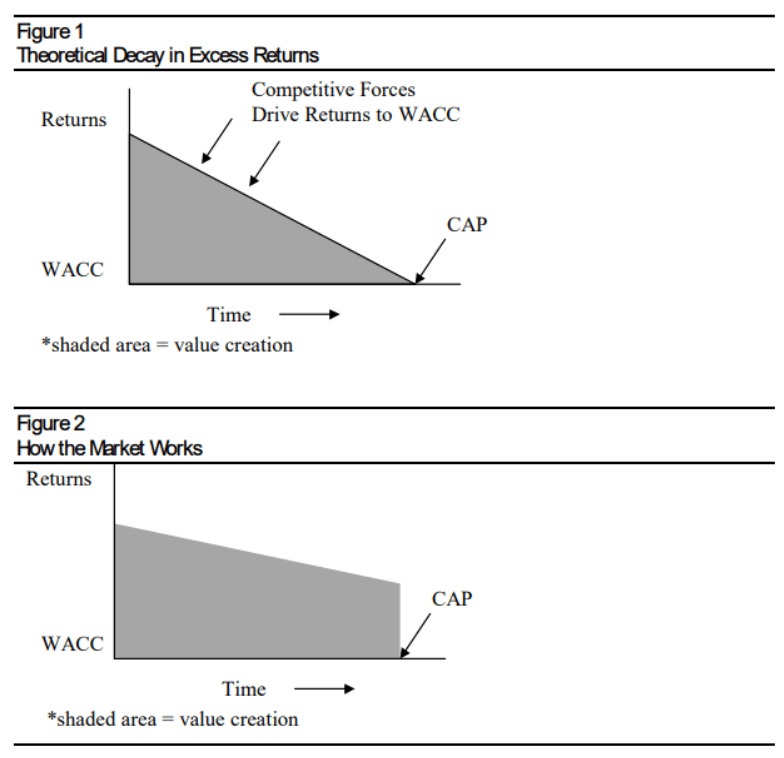
Economists interpreted this as being a linear, gradual process, like Darwinism. But if you analyze companies, you’ll see this is not that true.
Michael Mauboussin published an article called “CAP, The Neglected Value Driver” in the 1990s. Part of it is around this idea that the market was/is fundamentally wrong about forecasting cash flow. Corporate profits, seen from the capital investment point of view, represent the difference between the company’s return on capital and its cost of capital.
And the market believes/d that excess returns are driven to zero in a linear, gradual fashion.
That’s just not true. It kind of assumes the company’s moat eroding slowly over time. But what I understand happens is that the moat disappears almost overnight. The company enjoys excess returns on its capital until, suddenly and abruptly, it doesn’t anymore. It incidentally reminds me of Christensen’s idea of disruption.
30. Lollapalooza effect
Extraordinary outcomes are typically the result of a confluence of factors working in the same direction at the same time. Multiple things going for something makes it much more likely to happen. Munger explained the Lollapalooza effect through how mental models and biases operated together, leading to Coca-Cola’s astounding success, as well as to explain the Moonies cult conversion. The Lollapalooza effect’s power comes from helping you think in terms of parallel tailwinds.
31. Paint the fence
If something is not worth doing well, it might not be worth doing at all. Why do something that doesn’t make your soul smile?
Steve Jobs’s father was once working on their house’s fence. What caught Steve’s eye was that his father went to extraordinary lengths to ensure everything was perfect. He’d paint entire boards, even the back facing the alley, which nobody would see.
Steve took that to Apple. Open up their early computers or any other product and they are just as beautiful in the inside as in the outside.
Self-esteem is the reputation we have with ourselves. Even when no one else will know, you will know. So do a good job. If you’re gonna do something, you might as well do something useful, beautiful, and well crafted.
32. The role of technology is to make complicated and expensive things cheaper and more accessible
Von Neumann invented the first computer in the mid 40s; only he and a few other people could use it. Two decades later, IBM built a business out of installing mainframe computers; only technicians could use them and they cost north of
. Apple brought computing to larger masses of people through personal computers in the 80s; they cost $500-$3,000 and almost anyone could now use them without needed much technical ability. Phones and iPads led the subsequent charge; they cost hundreds of dollars and even toddlers can use them given how UI friendly they are.
That’s the role of technology. It makes a highly sought-after resource (computing + memory) more abundant. Its price and the barrier to use it fall
33. Attractor states
Free-market systems are those where there is no intervention in private parties’ transactions. People are free to buy or sell any given item. But, more importantly, they can choose the price at which they are willing to trade. This causes there to be two large groups of people:
a) Those who need the product and are willing to pay a certain price for it, ranging from A to Z.
b) Those who’d rather have money instead of the product, and are willing to exchange it at a price ranging from A to Z.
When you put these two groups in contact, a market for the product emerges. Its price will be bid higher or lower, driven by the transactions between individual buyers and sellers. Some people will want to buy the product to benefit from its usage, but they’ll be willing to pay up to a certain price. Others will ignore it altogether.
Some sellers will regard the item as valuable and ask lots of money for it. Others might want to get rid of the item, so they try to sell it as cheaply as they can. Others will be producers, who’ll sell it at a profit margin.
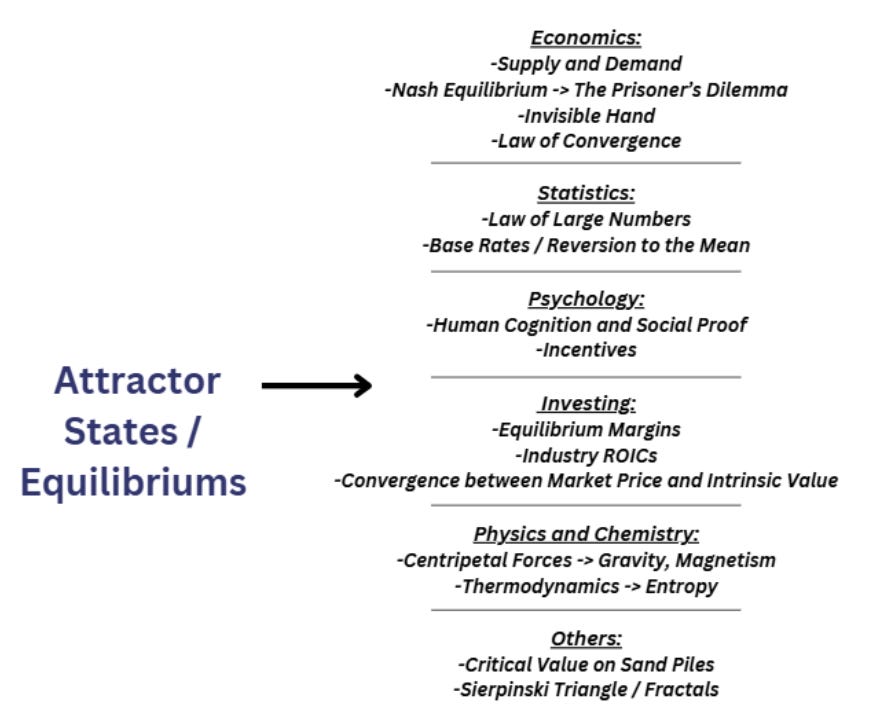
When you have a push-and-pull like this, the price will settle at an equilibrium. It is the price that represents people’s preferences, on a weighted average basis. Such a price will act as an attractor state.
This mental model of systems converging to an equilibrium is something I’ve seen everywhere. Think about your field, discipline, job, and interests. It is highly likely that things are naturally tending towards somewhere. Spotting that place can help you make much better informed decisions and give you a great advantage over others.
34. Make things as simple as possible, but not simpler - Einstein
Isaac Newton came up with a framework as fundamental as possible. He created a system for how the world works, based on 4 elements.
Inertia: That all bodies will tend to remain in their state of rest or moving uniformly in a rectilinear direction unless a force is impressed upon them.
Inverse reaction: That when a force is impressed upon something, the thing returns the same force to the object.
When a force is impressed upon an object, it’ll affect its trajectory, modifying it depending on the trajectory of the force and the force itself.
- Force = mass * accelerationUniversal gravitation, or the inverse square law: that all bodies attract one another with a force equal to constant * M1*M2 / squared distance between them.
These axioms and gravity explain the most complex set of phenomena:
Planetary orbits.
Tide motion.
The precession of the equinoxes.
We can only go as simple as our understanding permits. There are patterns even in things that look bizarre. Always strive for increasingly simpler frameworks. If you can’t explain it to a 5-year-old, you don’t understand it that well. And you don’t get rewarded for complexity; stepping over a one-foot bar might have the same result as stepping over a seven-foot bar.
“For the simplicity on this side of complexity, I wouldn’t give you a fig. But for the simplicity on the other side of complexity, for that I would give you anything I have.” - Oliver Wendell Holmes
35. Ideas are much older than you think
Three years ago, I was reading Jeff Bezos’s shareholder letters and felt amazed by two ideas: customer obsession and passing efficiency gains to the consumer. Then I looked at CostCo and figured these guys had been pushing these ideas since earlier. Then I read Home Depot founders’ autobiography; same ideas, highly similar framings even. Then I read Sam Walton’s autobiography; shared same values. And finally, Sam Walton points to the source of these ideas: Sol Price at FedMart and later at Price Club.
This has happened to me over and over again. I believe an idea to have originated at a certain point in time but, the more I read, the further back that idea can be traced. It feels like archaeology, which investigation always leads to stuff being older and older.
Don’t think you’re stealing an idea. In all likelihood, the person you thought invented it actually took it from someone else. Mankind has been around for a long time, and tens of thousands of years with a similar brain and environment. It’s natural for most ideas to have earlier roots.
36. Do what you love
Life is long enough to do anything, but not long enough to do everything. Choosing what to do means choosing what not to do. When facing relatively significant decisions, I find myself using the regret minimization framework: “When I am 80 years old, will I regret not doing this?” - Jeff Bezos
And do what you love; for the same reason. No one can beat you at being you. Work on things that feel like a fun hobby to you but heavy lifting to others.
You can very much fail doing something other people want, so you might as well take a shot at what you want. If you fail, it won’t be as terrible. But imagine failing at something you didn’t even want to do in the first place. That is a true waste.
37. True law is reason - Cicero
The affairs of man have been ruled by multiple forms of governments and structures. Good leaders and dictators have come and gone. Policies of the most varied nature implemented. Promises were responsible for despair and destruction. Much has been tried as to how to rule society.
Reason is what ties truth, God, and man. In any situation, what’s reasonable is what should be done. Malpractice should be penalized to the extent that reason permits.
People have an inner sense for morality and analysis. Oftentimes, human actions are strictly black or white. Whenever they fall into grey territory, good judgment is that which accords most with reason. It’s easy for majorities to prevail, but “for something to be rightful, it must be reasonable.” - Jefferson
When asked about whether the whole population or only a select group of people should vote, Jefferson pointed out the question was missing the point. The question, rather, is how many people should vote so that the most capable and honest person gets elected to the Office.
That democracy has evolved into a combat of extremes, whereby two parties focus on opposing each other rather than thinking about what’s truly useful, is a shame. They hate each other; and when anger arrives, reason leaves. We lose by trying to win.
38. You can’t teach an old dog to live in chains and you can’t teach old tricks to a new dog
You can’t change someone’s nature. If they don’t want to work hard, you won’t convince them to work hard. If someone is accustomed to freedom, you can’t chain them and teach them how to live with that. They’ll revolt. The more we’ve done of something, the more ingrained it is within us. Changing that deeply settled wiring is a bet that’s likely unprofitable.
Second quote comes from Warren. In business management, there’s no true retirement threshold. You can invest alongside a 50-year-old manager; if they love what they do, they still have a few decades ahead. It’s much easier to get these people right than it is to bet on an unproven new manager. People’s experience will work in your favor; you’ll avoid several costly mistakes every manager has to learn.
39. Knowers vs non-knowers
Whenever I hear “Adam Smith,” the person immediately parrots “the invisible hand.” As if the two were inextricably linked and the concept contained Smith’s whole philosophy.
It turns out the invisible hand is only one paragraph and it’s not even about what people talk about. Adam Smith speaks of it as being the thing that causes people to do what’s right for society when they do what’s right for themselves, “as though moved by an invisible hand.”
This has happened repeatedly to me. People will repeat what others say. Very few are willing to pay the dues and rightfully acquire the knowledge.
The world is full of non-knowers. They learned how to prattle the talk, but they don’t really understand what they’re saying. Ask them a few questions and there’ll be no sensible answers. They have not critically thought about the subject nor have they invested the years required to know it.
You must learn to discriminate between knowers and non-knowers. Only by discerning between the two will you rightfully delegate responsibilities or assign trust.
And I found two ways to learn this: (1) Read the source; (2) Become a doer, a practitioner - the real intellectual struggle happens when trying to take something from the idea to execution.
TL;DR - List of Ideas:
If you find a genius, give them all power
You are neither right or wrong because a poll agrees with you
The key to success is mediocre competition
There are answers worth billions of dollars in a $30 history book - Munger
Worldly wisdom
Incentives
It’s always a skill issue
Intelligent is different from smart, and both can be stupid
The men who can manage men manage the men who can manage only things, and the men who can manage money manage all.
Cargo Cult Science
Education is software for the brain
Economies of scale.
Quality
Extraordinary results are just 1,000 boring days strung together
Stack the bricks
There are multiple ways of thinking
Real understanding comes through continued mental exposure
Deep simplicity
Tweak a problem only slightly and you’ll turn it from impossible to easy
Systems naturally trend towards decentralization and specialization
Complex adaptive systems
Why thinking what no one else is thinking pays off enormously
The difficulty lies not in the new ideas, but in escaping from the old ones
You drift toward the average of your surroundings
Causes of human misjudgment
Find out what works and do it
After a business gets to scale, capital allocation matters more than any other thing
‘History doesn’t repeat itself but it often rhymes’
Uniformitarianism vs catastrophism
Lollapalooza effect
Paint the fence
The role of technology is to make complicated and expensive things cheaper and more accessible.
Attractor states
Make things as simple as possible, but no more simple.
Ideas are much older than you think
Do what you love
True law is reason - Cicero
You can’t teach an old dog to live in chain and you can’t teach old tricks to a new dog
Knowers vs non-knowers